|
|
|
How to choose the suitable load cell for your dynamometer.
|
There are certain parameters that should be known to understand how the SP3 works and to be able to choose the suitable load cell for our dynamometer:
|
Strenght (kg) = Torque (kg*m)/ lenght (meters) |
For example:
Torque=40 kg*m
lenght=20 cm (0.2 m)
Strenght=40 / 0.2 = 200 kg
For example, for 200kg max. a 225 kg or 250 kg cell could be good
Load cell calibration in four steps.
STEP ONE: Calibration at point of zero load.
|
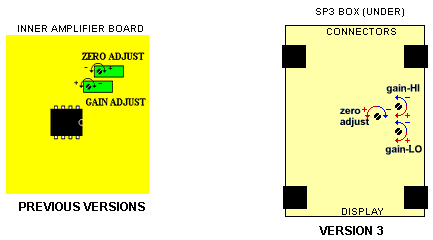
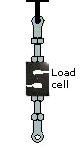
In this step, is needed to open the SP3 unit. The load cell is conected to the unit. No load is applied to the cell and the cell is fixed by its upper screw (the weight of the cell is suspended by itself) At this moment the unit should display the 0N reading, we should adjust the zero potentiometer until the reading will be zero. Note: the system doesn't show negative readings, what means that the amplifier can be working in the negative range of the scale, and we don't realized of this fact, so the right way to adjust the zero value is:to drive it to some positive value, and then drive it down slowly until it reachs the zero value, but don't continue moving the potentiometer.
|
STEP TWO: Calibration of the amplifier at full range of the cell
|
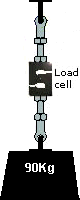
SP3 unit measures the strenght on the load cell as a value from 0 to 1000, but this values doesn't equates directly to strenght. For example, for the 90 kg cell, when measuring a 90Kg mass, the SP3 could display the next reading: 900N (N=newtons), but for the 225 kg cell, the unit can not measure upto 2250N, then as a rule, we will assume that the full range for SP3 will be always: the 950N value regardless the load cell type (in this way we leave a little margin to be able to read values out of the scale) With SP3 open, a known weight load is applied to the cell. For example a 90 kg load can be applied to the 90 kg load cell. And then, we will adjust the gain potentiometer until the SP3 unit will reach the 950N value. Note: SP3 unit is supplied with the gain ajusted. |
STEP THREE: Software calibration
|
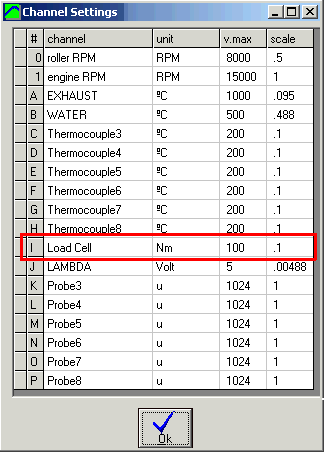
At full range conditions (as the preview step), we will setup the program so it will display the right torque value. At this moment the computer will receive the 950N readings, but depending on the load cell type, this value should be translated to a certain strenght value. And, also, depending on the lenght of lever, this strenght value should be translated to a certain torque value for the brake. So we need to calculate this conversion values.
|
|
The scale we will input on the channel configuration window, for load cell channel will be: scale = ( Cell full range (kg) / 950 ) * ( lever lenght (m) * 9.8 ) |
For example:
scale = 90 kg / 950 * 0.20 * 9.8= 0.0947368 * 0.20 * 9.8 = 0.18568
If the customer tells to us the lenght of the lever, this value will be supplied with the SP3 unit.STEP FOUR: Final Torque calibration
With load cell placed on the dyno and the program factor calculated, we can think that all adjust work is finished, because we know the lenght of the lever and the amplifier is calibrated, but this is not enough, because the angle between the cell and the lever is important, and we can not be sure that it is exactly a 90 degrees angle. Also, the exact lenght of the lever (between the center of the shaft and the center of the bearing of the cell) is unknown, and these values are very important in the torque calculation progress.
So, the way to do the Final calibration process is to calibrate the true torque on the roler, by using a second lever of 1 meter and applying to it a known weight (for example the maximum torque calculated at the begining of this page).
To do this step, first of all the lever should be placed on the brake, and the load cell has
to be removed from it, then, a with a set of masses, the weight of the lever should be balanced
so the brake will be stable.
Finally the load cell will be mounted again without removing the masses that keep the brake
stable.
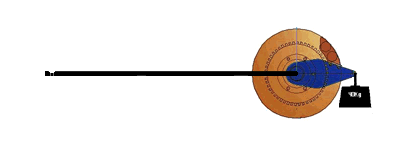
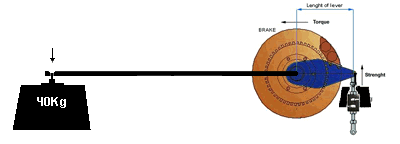
When doing this, if all the calculations were right, the value displayed at the computer screen should be the same as the torque applied at the long lever (in Newtons). For example, a 40 kg weight should be displayed as 40 * 9.8 = 392 Newtons on the screen
But is probable that the value was not the same, and then a final adjust should be done on the gain potentiometer, despite of changing the conditions adjusted for step 2
At least once per month, the zero value has to be verified, because the load cell is a affected a little by the temperature, but the corrections are often low.
 SmartPower SP-0