| |
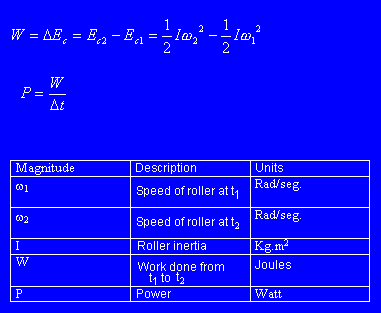
Building a dynamometerIn the following article the operation of a inertial dynamometer is explained from the theoretical base and the principle of operation until the practical examples with schemes and advices. ContentsPrinciple of operationThe power is defined as the capacity to make a certain work in a unit of time, in our case the work is used in accelerating a roller which we know its inertia, this work is the energy difference that there is between two moments of time.
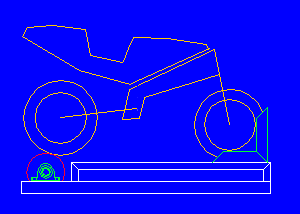
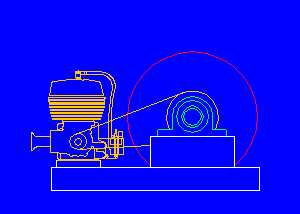
The speed is sent to the computer constantly, reason why the computer can calculate the work made in a time interval, and give us the power that has been provided to the roller. Go to topCharacteristics of an inertial testAn inertial test consists of accelerating a engine that has been connected to a inertial wheel in the range of revolutions that interests to us. If we do the test in the complete range of revolutions we obtain the power curve of the engine. The quality of the results depends mainly on the inertia of the inertial wheel, when the engine has been accelerating consumes part of the energy that is able to provide in accelerating its own rolling elements (crank, toothed wheel, the clutch, wheels, etc...) that also have their inertia, reason why the inertia of the roller must be bigger that the one of the equivalent inertia of the rolling parts of the engine. Another reason by that a long test is recommended is that the engine not working in optimal conditions when it accelerates, the engine are continuously adapting to the new regime of work. the test must be the most nearly posible to a stationary test. Go to topType of dynamometers
info@sportdevices.com to contact SportDevices.com |